
How to Brew Decaf Coffee at Home (That Actually Tastes Good)
Most flat, lifeless decaf isn't a decaf problem. It's a brewing problem. The beans are fine. The temperature, the grind, and the ratio are working against them.
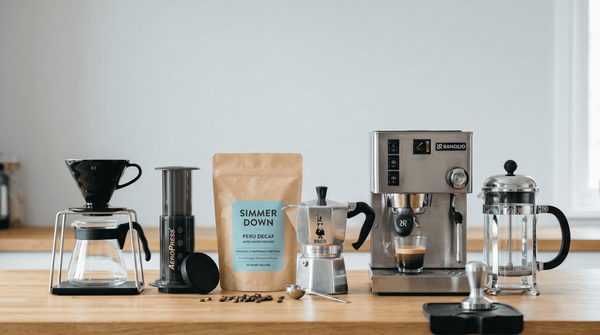
Decaf coffee behaves slightly differently from caffeinated coffee in the cup — not dramatically, but enough that the generic guidance (96°C, medium-fine grind, job done) tends to pull a little too hard and leave a bitter, papery edge where there should be sweetness. This guide covers every main home brew method with the specific adjustments that fix that: temperatures, ratios, grind settings, and the one thing about Swiss Water decaf that changes how fast it extracts.
By the end you'll know exactly what to adjust for your machine, why it matters, and what a well-brewed decaf is actually supposed to taste like.
Why Decaf Brews Differently
The decaffeination process — particularly Swiss Water — works by soaking green beans in water to draw out the caffeine. It's a gentle, chemical-free method, but it does have one side effect that matters for brewing: it slightly opens the bean's cell structure.
The practical result is that decaf extracts a little faster than caffeinated coffee at the same grind size and temperature. Push it too hard — grind too fine, water too hot — and you'll hit over-extraction before the good flavours have a chance to come through. The result is bitterness and a flat, papery aftertaste that has nothing to do with the quality of the bean.
Two small adjustments close most of that gap:
- Go 1–2 clicks coarser than your usual setting for the same brew method
- Drop your water temperature by 3–5°C — so if you'd normally use 94–96°C for caffeinated coffee, pull it back to 90–93°C for decaf
That's most of the work done. The rest is method-specific.
The Right Ratio for Decaf
Start here before dialling in your method. A 1:16 ratio (1g coffee to 16g water) is a reliable baseline for filter methods. For espresso, the standard 1:2 ratio works well — 18g in, 36–38g out.
Decaf tolerates a slightly wider ratio than caffeinated coffee because post-process the bean is a little less dense. Going to 1:17 or 1:18 won't thin the cup the way it might with a fresh-crop single origin. If your decaf tastes weak or watery, check the grind and temperature before pulling the ratio tighter — under-extraction is almost always the culprit, not too much water.
Quick reference — decaf brew settings at a glance:
|
Method |
Coffee |
Water |
Temperature |
Notes |
|
Espresso / bean-to-cup |
18–19g |
36–38g out |
90–92°C |
Pull slightly short for richer body |
|
Cafetiere |
15g |
250ml |
92–93°C |
4 min steep; pour immediately |
|
AeroPress |
15g |
240ml |
88–90°C |
2–2.5 min; inverted method recommended |
|
Pour-over (V60/Chemex) |
15g |
250ml |
91–92°C |
30s bloom; total 3–3.5 min |
|
Moka pot |
Fill basket level |
Fill reservoir |
Low heat |
Remove at first hiss |
Decaf Brew Method Guides
Pick your method and work through the steps below. Each section covers grind setting, ratio, temperature, and the specific adjustments that work for Simmer Down.
Espresso and bean-to-cup machines
Decaf espresso is where most people run into trouble first. The bean-to-cup machine is set up for caffeinated beans, everything looks the same, and yet the shot pulls fast and tastes thin or sour.
The fix is straightforward. Grind 1–2 steps coarser than your usual setting. Aim for 18–19g in, 36–38g out, in 28–32 seconds. Water temperature at 90–92°C — most machine displays let you adjust this; if yours doesn't, a short pre-heat purge before pulling the shot can help.
Simmer Down has vanilla fudge and caramelised biscuit notes. Those come through best in a slightly shorter shot — pull at 36g rather than stretching to 40g. With milk it becomes very close to what a good dark-roast espresso tastes like. The crema will be lighter than you're used to. That's normal with decaf; it's not a sign the extraction is off.

Cafetiere
One of the most forgiving methods for decaf. Coarse grind, around the texture of coarse sea salt. 15g coffee to 250ml water at 92–93°C.
Four minutes steep. Then plunge gently and pour straight away — don't leave the coffee sitting on the grounds once it's done, because decaf over-steeps faster than caffeinated coffee and the bitterness creeps in quickly. You'll get a full-bodied cup with the caramel and biscuit notes sitting comfortably in the background.
If you're sensitive to acid, this method suits Simmer Down particularly well. The low-acid profile of the beans — an advantage of both the origin and the decaffeination process — comes through cleanly in a cafetiere.

AeroPress
15g of coffee, 240ml of water at 88–90°C. Medium-fine grind, slightly coarser than you'd use for espresso but not as open as cafetiere.
The inverted method gives you more control over steep time. Steep for 90 seconds to 2 minutes, then flip and press slowly over 30 seconds. Total brew time around 2–2.5 minutes.
The AeroPress rewards a bit of experimentation with decaf. The lower temperature (88–90°C rather than the 92–96°C you might use with caffeinated beans) pulls back the extraction rate to match the bean's faster diffusion. The result is cleaner and sweeter than you'd expect — the natural sweetness from the Peru origin comes through well in this method.

Pour-over (V60 / Chemex)
15g coffee, 250ml water at 91–92°C. Medium grind — if you're used to dialling in for V60 with caffeinated beans, go one or two settings coarser.
Bloom with 30g of water for 30 seconds to let the gas escape. Then pour in steady circles, targeting a total brew time of 3–3.5 minutes. If it's running fast (under 2.5 minutes), grind slightly finer. If it's stalling, coarsen.
Pour-over is the method that most rewards a high-quality Swiss Water decaf. The slower extraction pulls out the sweeter, more complex notes — and because Simmer Down is single origin rather than a blend, there's a distinct flavour profile to chase. The roast leans medium-dark, so expect body and sweetness over brightness.

Moka pot
Fill the basket level — don't tamp. Medium-fine grind, finer than filter but not as fine as espresso. Fill the water reservoir to just below the pressure valve.
Low heat throughout. Remove the moka pot from the heat as soon as you hear the hiss — that gurgling sound means the water is getting too hot and the extraction is pushing into bitterness. With decaf this matters more than with caffeinated beans because you've got less buffer before things go wrong.
Moka pot decaf is naturally concentrated. Cut it with hot water for an Americano-style drink or add hot milk for something closer to a flat white. Don't try to brew it weaker by using less coffee — it just makes extraction uneven.

Common Decaf Brewing Mistakes
Most bad cups of decaf trace back to one of these:
Brewing too hot
The most common mistake. Standard coffee guides say 94–96°C. For decaf, that's usually 3–5°C too high. Drop to 90–93°C and the bitter, papery edge disappears.
Grinding too fine
Decaf extracts faster. A grind that works perfectly for caffeinated beans can over-extract decaf in the same brew time. Go coarser by 1–2 steps as your starting point.
Buying pre-ground
Decaf oxidises faster than regular coffee once it's ground. Buy whole beans and grind fresh — the difference in cup quality is immediate. If you don't have a grinder, buy in smaller quantities so the grounds are still fresh when you reach the bottom of the bag.
Using old beans
Decaf doesn't improve with age. Fresh-roasted beans make a bigger difference here than with caffeinated coffee, because the flavour compounds that survive the decaffeination process are more delicate. Simmer Down is roasted to order and ships the same week — use it within six weeks of the roast date for the best results.
Leaving coffee on the grounds
For cafetiere and AeroPress especially: brew to time, then separate immediately. Decaf keeps extracting in a cafetiere if you don't pour it off, and the extra extraction time gives you bitterness rather than more flavour.
Which Decaf to Use
The guidance above is written around Simmer Down — our Swiss Water, single-origin Peru decaf, organic and Fairtrade certified, with notes of vanilla fudge and caramelised biscuit. It suits every method in this guide, from espresso through to pour-over. The Great Taste judges described it as 'a darker roast that delivered a rich crema. With milk, it becomes a vanilla fudge: soft, round, full of malt and with a pleasingly long finish.' We've been selling it for over ten years. It's not available in supermarkets.
If you're stepping down from regular coffee rather than cutting it out entirely, the Simmer Down half-caff is the same origin and process but blended to reduce the caffeine more gradually.
Does Brewing Method Affect How Much Caffeine You Get?
Yes, but the differences are small. Swiss Water decaf starts at 99.9% caffeine-free, so even if your brewing method extracts caffeine slightly more efficiently, you're starting from a very low baseline. Espresso extracts a higher concentration per millilitre than filter coffee, but the typical serving size is smaller, so the total caffeine per cup is broadly similar across methods.
If you're managing caffeine intake carefully — for medical reasons, pregnancy, or sensitivity — the full breakdown is in our guide to how much caffeine is in decaf coffee. The short version: a cup of well-brewed Swiss Water decaf typically contains 2–5mg of caffeine, compared to 80–120mg in a standard filter coffee.
The difference between a flat, disappointing decaf and a genuinely good one almost always comes down to temperature and freshness, not the decaffeination process itself. A good Swiss Water bean, brewed at 90–93°C with a slightly coarser grind, tastes like coffee. The caffeine is the only thing missing.
If you want to go further on the process side — why we chose Swiss Water over other methods, how the carbon filtration actually works — the full explanation is in our Swiss Water Process guide.

